
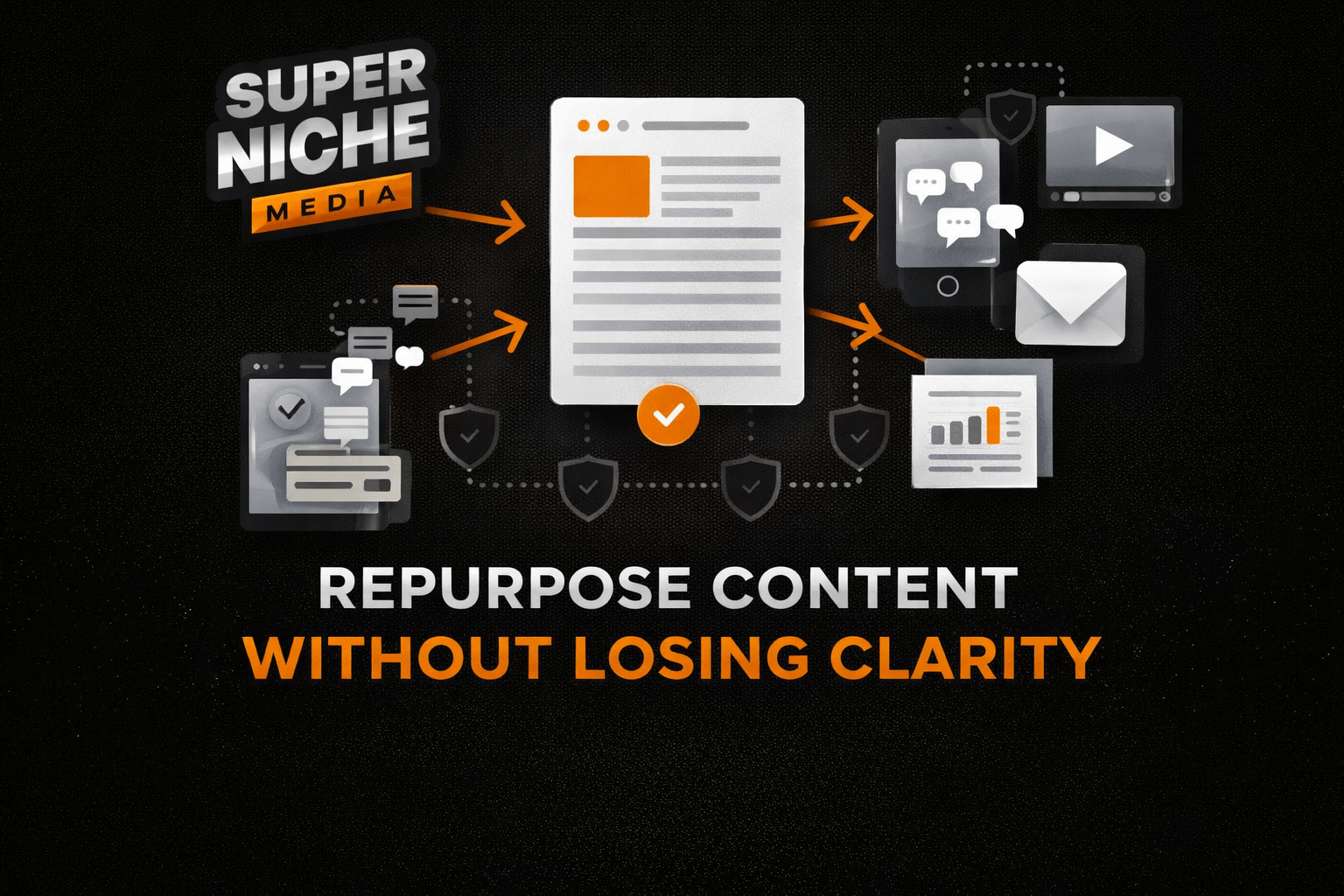
Small teams rarely have the luxury of creating every asset from scratch. Time is tight, attention is limited, and content still needs to show up with consistency. That pressure makes repurposing a smart move.
The risk sits in the execution. A brand can lose shape when one article turns into five social posts, an email, a short video, and a sales deck with no shared message. The content keeps moving, yet the identity gets fuzzy.
A better approach keeps the message stable across every format. The team saves time, the audience hears a familiar voice, and the brand becomes easier to recognise.
Why Repurposing Can Blur Brand Clarity
Repurposing often fails at the point where teams focus on volume first. The content starts to stretch into new formats, and the core message starts to thin out. A company can publish more and still sound less certain.
Here are the pressure points that tend to blur a brand.
Treating Every Channel As A New Voice
A social caption does not need to sound like a white paper. The tone can shift to match the platform. The voice still needs to feel like it came from the same organisation.
Trouble starts when every channel gets its own personality. LinkedIn sounds formal. Email sounds casual. Sales decks feel clinical. Blog posts drift into broad language that could belong to any firm in the market. Once that happens, repurposing starts to create confusion instead of recognition.
Chasing Format Over Message
Some teams become too focused on the output. They ask for a carousel, a reel, a newsletter and a landing page, then forget the point that made the original asset worth publishing.
A strong source piece carries a clear idea. Every new format should carry that same idea in a form that suits the channel. When the format becomes the main event, the message loses its weight.
Publishing Without A Core Point Of View
Brand clarity comes from a stable point of view. Readers should know how your company thinks, what it values and the kind of problems it is built to solve.
Repurposing without that foundation creates content that feels organised and empty. The assets look connected on a calendar, yet they do not deepen trust.
Build A Repurposing System That Protects The Brand
A small team needs a process that feels simple enough to repeat and strong enough to keep the message intact. Repurposing works best when the source asset carries the main idea, the proof points and the intended audience from the start.
These are the parts of a system that keep the message steady.
Start With A Strong Source Asset
Not every piece deserves to become five more. A useful source asset usually answers one meaningful question, presents one clear argument or frames one challenge with a practical view.
That source might be a blog article, webinar, client Q and A, founder note or sales call summary. The format matters less than the strength of the idea. If the original piece feels vague, every spin-off asset will feel vague too.
Create A Message Hierarchy
A message hierarchy keeps the brand from drifting. It gives the team a simple map for every adaptation.
| Layer | What It Covers | Example |
|---|---|---|
| Core Message | The main idea that stays fixed | Small teams need repeatable content systems |
| Supporting Points | Proof, examples or lessons | Batch production, channel rules, review steps |
| Channel Angle | The shape that suits each format | Email summary, short post, webinar clip |
| Call To Action | The next step for the reader | Book a strategy call or read the full guide |
This table turns repurposing into a controlled process instead of a reactive one.
Keep The Core Message Fixed
The main point should not change from one channel to another. Every version should still sound like the same argument.
Adapt The Supporting Points
A blog can hold depth. A social post needs one sharp thought. An email can frame the problem and point to the fuller piece. The format can flex. The core message stays put.
Set Channel Rules Before Production Starts
Every team benefits from a simple set of channel rules. That might include sentence length, preferred tone, CTA style, reading level or visual cues. These rules reduce guesswork and make approvals faster.
A short rule set can cover the essentials.
- One voice across every platform
- One CTA per asset
- One audience pain point per post
- One proof point that supports the main idea
- One final review for tone and clarity
Practical Repurposing Ideas For Small Teams
A lean team needs content moves that create reach without creating chaos. The simplest method is to repurpose from one high-value asset into a small number of connected pieces.
These are practical ways to stretch a strong idea without weakening the brand.
Turn One Thought Leadership Article Into A Content Cluster
A strong article can support several assets across a week or a month. Each one should serve a different reading habit or decision stage.
A single article can become
- Three LinkedIn posts that frame separate points from the piece
- One short email that highlights the strongest takeaway
- One sales enablement note for discovery calls
- One FAQ for the website
- One short script for a founder video
This gives the team more mileage from the same idea and keeps the message recognisable across touchpoints.
Turn One Client Question Into A Series
Client questions often make the strongest source material. They reflect real friction, real buyer language and real commercial tension.
A repeated sales question can become a blog article, a one-minute video, a short PDF, a webinar topic and a call follow-up email. That sequence feels cohesive since every asset answers the same concern from a slightly different angle.
Turn One Case Study Into Multiple Proof Assets
Case studies often sit untouched after publication. That leaves value on the table. A single project story can support trust across several channels.
Pull out the challenge, the decision, the process and the outcome. Each element can stand on its own. The team gets several proof-driven assets without inventing a fresh idea each time.
Review Every Asset Before It Goes Live
Repurposing saves time. It still needs a final check. A short review step helps protect the brand from drift, mixed tone and weak calls to action.
These are the checks that matter most before publishing.
Voice And Tone Check
Read the asset out loud. The phrasing should sound familiar to anyone who knows the brand. If the language feels generic, polished to the point of emptiness or too far from your normal tone, revise it.
Audience Fit Check
Each asset should speak to a clear reader. That means one audience problem, one point of relevance and one reason to care. A post written for everyone rarely lands with anyone.
Call To Action Check
Every piece needs a next step that fits its role. Some assets should educate. Some should prompt a reply. Some should direct the reader to a deeper resource. The CTA should feel natural for that stage of the journey.
Final Thoughts
Repurposing helps small teams stay visible without burning time on constant reinvention. The value comes from discipline, not volume. A clear source asset, a stable message hierarchy and a simple review process can keep the brand sharp across every format.
When the voice stays recognisable and the message stays intact, repurposed content stops feeling recycled. It starts to feel deliberate, organised and worth paying attention to.